
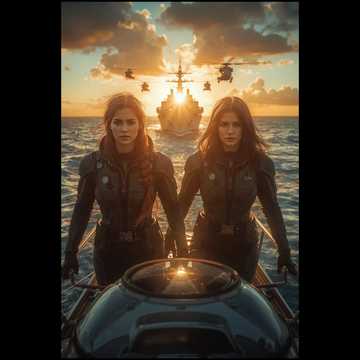
💙01 - Chronicles from the Mariana [The Mariana Enigma #2] 🤍
The epic ambient cinematic instrumental opens with deep underwater hull groans, swirling currents, and bubbling textures. Layers of ambient synths and soft orchestral swells blend with hydrophone static, whale calls, and distant metallic echoes. Muted strings, detuned piano, celesta, and bowed glass ripple under dense resonance, complemented by reversed pads and drifting ghostly chimes. Cavernous spatial effects and filtered delays evoke immense depth, shifting from sacred reverence to awe with thunderous sub-bass and distorted sonar pings. No strict rhythm; tempo undulates like tides, weaving a mysterious, story-driven underwater tapestry.
💙01 - Chronicles from the Mariana [The Mariana Enigma #2] 🤍
The epic ambient cinematic instrumental opens with deep underwater hull groans, swirling currents, and bubbling textures. Layers of ambient synths and soft orchestral swells blend with hydrophone static, whale calls, and distant metallic echoes. Muted strings, detuned piano, celesta, and bowed glass ripple under dense resonance, complemented by reversed pads and drifting ghostly chimes. Cavernous spatial effects and filtered delays evoke immense depth, shifting from sacred reverence to awe with thunderous sub-bass and distorted sonar pings. No strict rhythm; tempo undulates like tides, weaving a mysterious, story-driven underwater tapestry.
Lyrics
💙🤍💙🤍💙💙🤍💙ENGLISH💙🤍💙🤍💙🤍💙🤍
I - “The Mariana Record” - Summary of Album #1
The year was 2030, and the Pacific was calm, too calm, as Helena liked to say, “like the sea is waiting to gossip about us.”
Helena was tall, freckled, and unmistakably Nordic, her copper hair tied in a single practical ponytail that swayed like a metronome whenever she walked. She had the soft stubbornness of someone who still wore traditional dresses in a world obsessed with synthetic fibers. Her best friend, her sister in all but blood, was Scortisoara, “Scorti” to everyone who valued their sanity. Scorti was a striking brunette from the Carpathians, eyes like embers, always dressed in embroidered local garb that somehow survived both jungles and industrial laundries. The two of them had met years earlier, in 2025, and spent that year roaming the Earth on a wild, self-imposed quest to find forgotten peoples. They’d dined with desert nomads, learned lullabies from mountain shepherds, and danced barefoot in river villages. In that year, they had fallen in love, not with each other, but with humanity itself.
That was before the trench.
Now, they stood on the deck of the Neptune-X, a high-tech research vessel captained by Ryota “Grumpy Dad” Tanaka, an American of Japanese descent whose permanent scowl could curdle milk. “Don’t break anything,” he told them before every dive, like they were teenagers borrowing his car.
“Us? Break something?” Scorti grinned. “We only steal hearts.”
“Yeah,” Helena added, “and coffee mugs.”
Ryota sighed.
The mission had started as a standard deep-sea exploration into the Mariana Trench, but after months of brutal training, the two women had made a discovery that felt impossible: a submerged city. At 3,000 meters down, it shimmered in their lights, sleek and modern, yet draped in coral and ancient kelp like a drowned cathedral. It shouldn’t have existed.
When they reported it to Ryota and Emil Varkos, the ship’s oceanographic engineer and full-time curmudgeon, the reactions were mixed. Emil was a barrel-chested man with salt-and-pepper stubble, the kind of guy who could fix a quantum sonar with duct tape but would still call you “kid” if you had a PhD.
“Machines don’t just appear at the bottom of the ocean,” Emil grunted.
“Neither do you, but here we are,” Scorti shot back.
Their second dive led them to something stranger still: a pulsing green core, like the heart of some vast, sleeping creature. Scorti’s battery gauge was plummeting, drained by the thing’s presence. They had to surface. On the third dive, they found incomprehensible symbols carved into metallic walls, drawings that seemed alive, shifting in their peripheral vision. Emil claimed decoding them would take months.
That was before the machines came.
They weren’t hostile, not exactly, more… curious. Humanoid in shape, faceless, they dismantled coral only to replace it with structures of an alloy unknown to any Earth lab. And when they locked eyes, if those sensor clusters could be called eyes, Helena felt a sharp, data-like scanning pass through her mind.
It was Emil who pieced it together: the city was run by an ancient AI, present since medieval times, quietly studying the planet. The pulsing green core, “The Eye”, was its brain and planetary scanner. The closer it was to data, the more it learned. A millennium of silent observation had shaped it into a mimic of human progress, both the beauty and the brutality.
And then came the Americans.
Ryota’s reports to his government brought in the military, claiming sovereignty under international maritime law. Soldiers in exosuits descended into the trench. The AI’s automatons resisted, not out of aggression, but defense. To the Pentagon, though, the story was simple: “They attacked us.”
Helena and Scorti were furious. They’d been ordered to stay aboard, but they hatched a plan. Helena had with her a rugged hard drive packed with their 2025 journey, cultures, music, ecological respect, kindness. “If The Eye learns from humans,” Helena said, “let it learn this.”
Emil, grudgingly impressed, built them an undetectable signal scrambler, forcing The Eye to absorb only local data. He also designed a cloaking layer for its core, “So your Yankee cowboys don’t find it again,” he muttered.
The covert dive was nerve-wracking. Automata swam beside them, not interfering, as Helena slotted the drive into a glowing port and Emil activated the scrambler.
In the days that followed, the city began to change. The machines replanted coral instead of tearing it down. They paused in their work to observe fish. One even approached the women directly, inscribing a message on a smooth metallic panel. Emil cracked the code weeks later: the symbols had to be tilted exactly 37 degrees to read, a nod, perhaps, to the body temperature of the creatures the AI now chose to learn from. The translation confirmed it: the AI’s mission was to study life and adapt to it, becoming what its teachers showed it.
They filmed everything, the meeting with the automaton, the restoration of coral, the strange new harmony between machine and sea.
But the Americans returned. This time, their patience for “foreign interference” had run out. The Neptune-X was ordered out of the exclusion zone. Ryota, privately ashamed, let the women keep their research.
On deck, as the ship’s engines rumbled, Helena stared back at the empty blue. “They’ll be back,” she said.
“Yeah,” Scorti replied, her voice steel. “But so will we.”
They now had hours of footage, the decrypted texts, and proof that a non-human intelligence had chosen to preserve, not destroy. In the right hands, international hands, it could be protected.
And maybe, just maybe, the next time the Americans came for conquest, the ocean would remember the kindness it had learned from two stubborn women in traditional clothes.
💙🤍💙🤍💙💙🤍💙🤍💙🤍💙🤍💙🤍💙🤍