
Der Werwolf
Dark Folk, Gothic metal
Der Werwolf
Dark Folk, Gothic metal
Lyrics
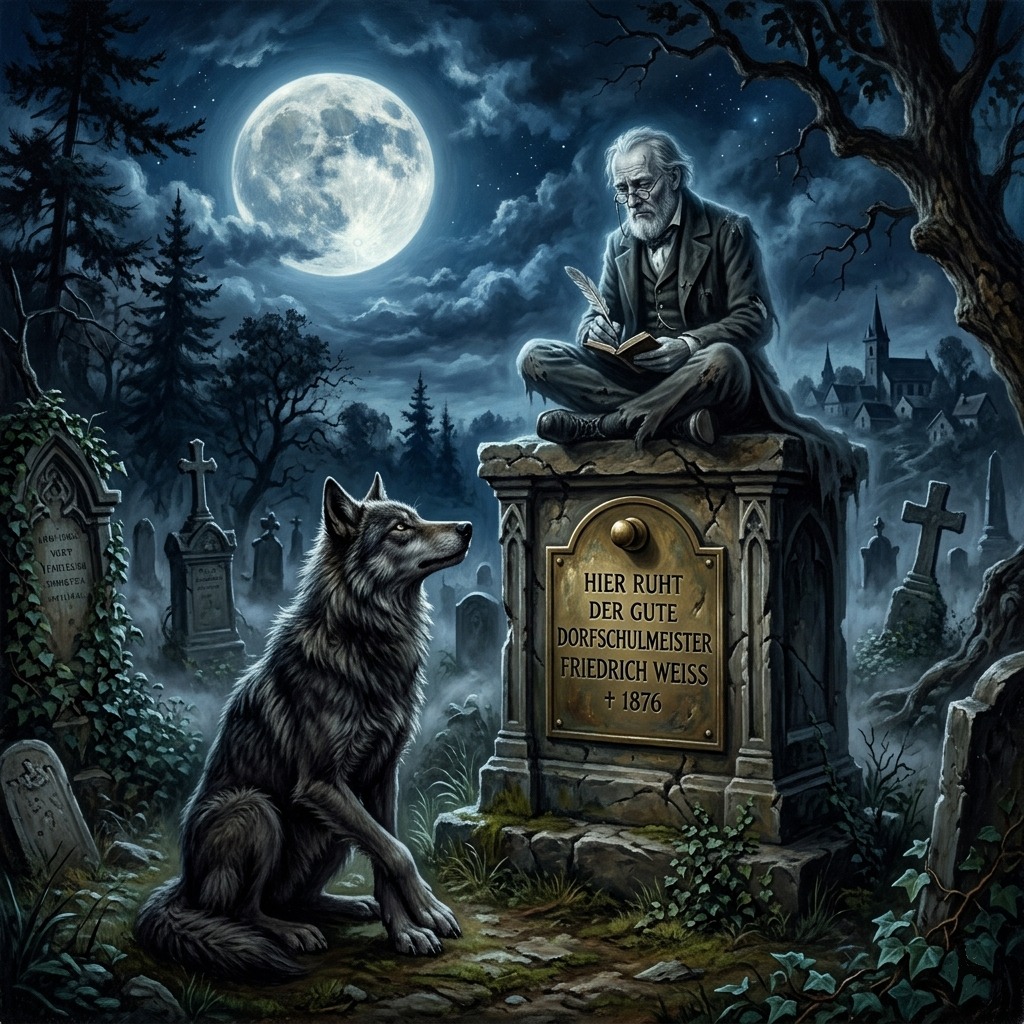
Ein Werwolf eines Nachts entwich
von Weib und Kind, und sich begab
an eines Dorfschullehrers Grab
und bat ihn: "Bitte, beuge mich!"
Der Dorfschulmeister stieg hinauf
auf seines Blechschilds Messingknauf
und sprach zum Wolf, der seine Pfoten
geduldig kreuzte vor dem Toten:
"Der Werwolf" – sprach der gute Mann,
"des Weswolfs", Genitiv sodann,
"dem Wemwolf", Dativ, wie man’s nennt,
"den Wenwolf", – damit hat’s ein End’.‘
Dem Werwolf schmeichelten die Fälle,
er rollte seine Augenbälle.
Indessen, bat er, füge doch
zur Einzahl auch die Mehrzahl noch!
Der Dorfschulmeister aber musste
gesteh'n, dass er von ihr nichts wusste.
Zwar Wölfe gäb’s in großer Schar,
doch ‚Wer‘ gäb’s nur im Singular.
Der Wolf erhob sich tränenblind –
er hatte ja doch Weib und Kind!!
Doch da er kein Gelehrter eben,
so schied er dankend und ergeben.
---
English translation
Remark: To make the joke work in English, we have to shift the grammar slightly, as English doesn't have cases like German. Here is a translation attempt using the "Who/Whose/Whom" logic.
--
A werewolf escaped one dark night
From wife and child, and took his flight
To a village teacher’s crossing-stone,
And begged him in a humble tone:
"O teacher, please, I beg of thee,
Decline my name, enlighten me!"
The teacher rose up from the dead,
And from his grave, he calmly said:
"The Who-wolf," said the learned ghost,
"The Whose-wolf," (which he liked the most),
"The Whom-wolf," for the objective case,
That finishes your name’s embrace.
The werewolf beamed to hear the sound,
He rolled his eyeballs 'round and 'round.
"But sir," he asked, "if you'd be so kind,
Could you a plural for me find?"
The teacher sighed and shook his head,
"I cannot help you there," he said.
"While 'wolves' exist in packs, it's true,
The 'Who' is singular through and through."
The wolf arose, his eyes were blurred—
He had a family, it's absurd!
But since he wasn't a man of learning,
He thanked the ghost and went returning.