
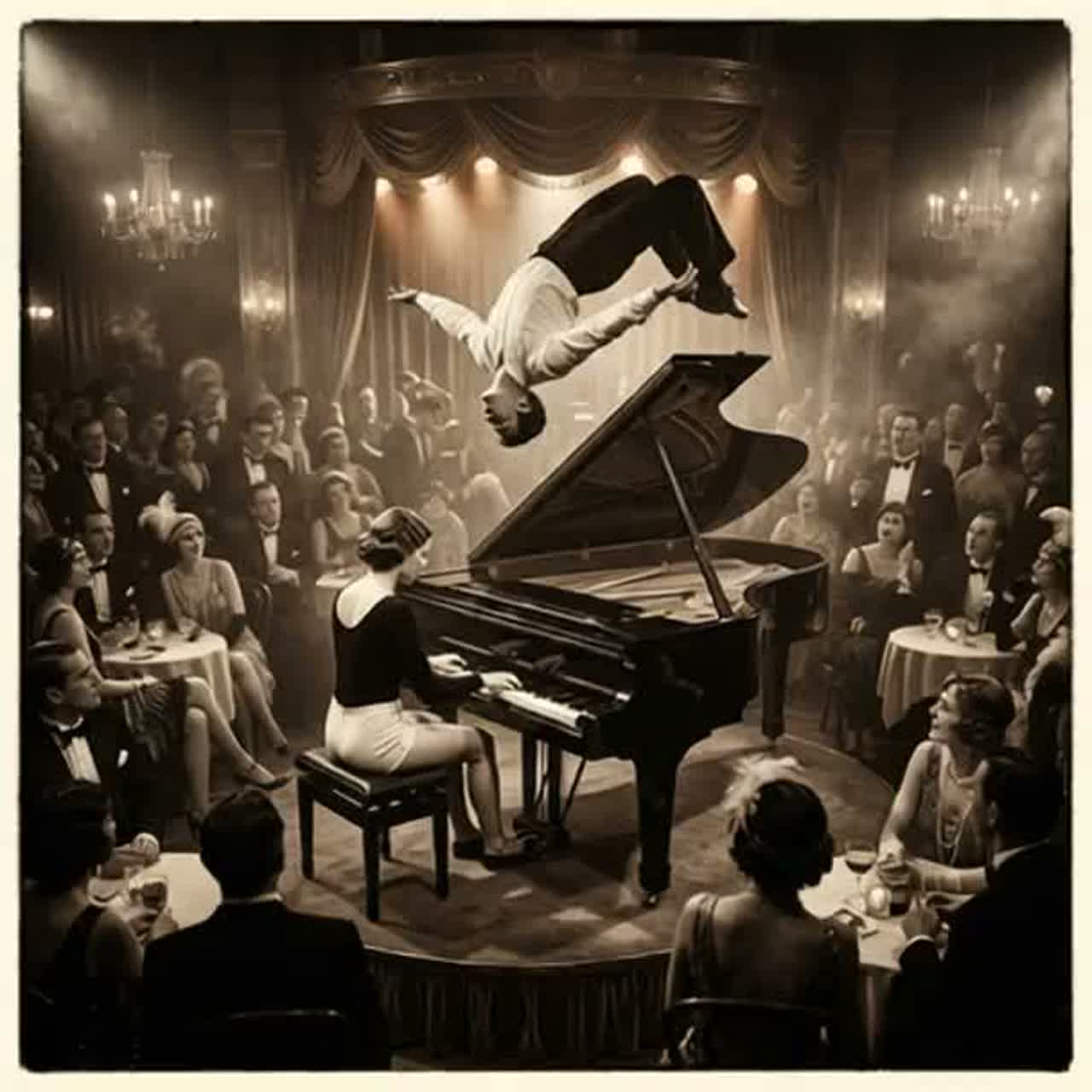
Turner-Marsch
Contemporary piano ballad, Grand piano, melodic pop, male baritone, smooth vocals, emotional love song, intimate, clear production, modern classical crossover, soulful, German lyrics
Turner-Marsch
Contemporary piano ballad, Grand piano, melodic pop, male baritone, smooth vocals, emotional love song, intimate, clear production, modern classical crossover, soulful, German lyrics
Lyrics
"Turner-Marsch" by Joachim Ringelnatz
from "Joachim Ringelnatzens Turngedichte" (1920)
Subtitle: (Melodie: Leise flehen meine Lieder)
****
To avoid misunderstandings, here are a few clarifications:
This poem from 1920 and its musical setting satirize the "national-educational" gymnastics movement ("Turnerbewegung"), which took itself far too seriously with its (quasi-)military pathos ("Marsch"="March" or their greeting 'Gut Heil' which Ringelnatz deliberately shortened to the völkisch 'Heil!').
Key explanations:
"Felix Dahn" instead of "Friedrich Ludwig Jahn":
Ringelnatz does not write "Vivat Vater Felix Jahn!"—the actual founder of the movement—but instead invokes Felix Dahn, the author of the bestselling novel "Ein Kampf um Rom" (A Struggle for Rome, 1876). Dahn was a popular nationalistic poet known for a Germanic-heroic style and Völkisch leanings, yet he was not a gymnast himself. This deliberate substitution is both absurd and revealing: the movement pays homage to interchangeable Germanic father figures, where one is as good (or as hollow) as the other.
"Faltet die Fahnen ent!" (Un-furl the flags!):
The fractured German—using the non-standard "ent-" prefix at the end—mimics a parodied military command tone that has spiraled out of grammatical control. It highlights the rigid yet nonsensical nature of such drills.
"Hepp-hepps"
While translated here as "Hip-hips," in the German context, "Hepp-hepp" also alludes to the antisemitic Hep-Hep riots (Hep-Hep-Krawalle) of 1819, and therefore to the antisemitism within the movement
"Daß einst um eure Urne / Eine gleiche Generation turne."
"That one day around your urn / A similar generation may perform gymnastics":
This is the poem’s climax. The nationalistic pathos culminates in death. The image of the next generation performing gymnastics around the gravestones is a macabre look into the future.
The Musical Contrast:
Instead of military march music ("Turner-Marsch"), Ringelnatz instructs that "Leise flehen meine Lieder" be played. At the time, an audience would likely have associated this with Schubert’s Serenade "Ständchen" (No. 4 of Schwanengesang, D 957). This creates a stark contrast between the rigid, martial rhythm of a march and languid, yearning Romanticism, causing the military element to lose its authority and become comical.
---
Lyrics: (English translation below)
---
Schlagt die Pauken und Trompeten,
Turner in die Bahn!
Turnersprache laßt uns reden.
Vivat Vater Felix Dahn!
Laßt uns im Gleichschritt aufmarschieren,
Ein stolzes Regiment.
Laß die Fanfaren tremulieren!
Faltet die Fahnen ent!
Die harte Brust dem Wetter darzubieten,
Reißt die germanische Lodenjoppe auf!
Kommet zu Hauf!
Wir wollen uns im friedlichen Wettkampf üben.
Braust drei Hepp-hepps und drei Hurras
Um die deutschen Eichenbäume!
Trinkt auf das Wohl der deutschen Frauen ein Glas,
Daß es das ganze Vaterland durchschäume.
Heil! Umschlingt euch mit Herz und Hand,
Ihr Brüder aus Nord-, Süd- und Mitteldeutschland!
Daß einst um eure Urne
Eine gleiche Generation turne.
---
---
English translation:
---
Sound the kettledrums and trumpets,
Gymnasts, take the floor!
Let us speak the gymnasts' tongue.
Long live Father Felix Dahn!
Let us march forth in lockstep,
A proud regiment.
Let the fanfares tremulate!
Un-fold the flags!
To offer the hardened chest to the weather,
Tear open the Germanic loden jacket!
Gather in throngs!
We wish to practice in peaceful competition.
Roar three Hip-hips and three Hurrahs
Around the German oak trees!
Drink a glass to the welfare of German women,
That it may foam through the entire Fatherland.
Hail! Embrace with heart and hand,
You brothers from North, South, and Central Germany!
That one day around your urn
A similar generation may perform gymnastics.