
Bronco's History
Bronco
Bronco's History
Bronco
Lyrics
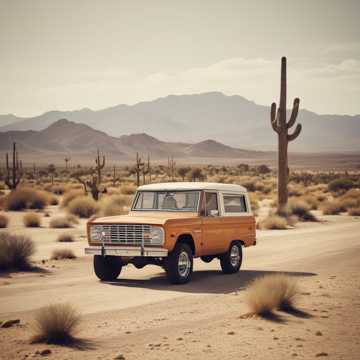
In 1966, while remnants of confetti still floated in the air from Ford’s unveiling of the original Mustang, the four-wheel-drive Bronco made its debut in wagon, pickup, and roadster body styles—all furnished with a mere two doors. The lion’s share of production was managed at Ford’s assembly facilities in Wayne, Michigan, and Valencia, Venezuela. Perched atop a stubby 92-inch wheelbase and built on its own dedicated platform, the first-generation Bronco was an unpretentious, utilitarian vehicle reminiscent of agrarian machinery. It featured solid axles both front and rear, and its angular, if not timeless, sheetmetal design would undergo minimal evolution during its 12-year production tenure. Notably, the substitution of conventional leaf springs with coil springs at both ends rendered the Bronco surprisingly nimble, affording it enhanced wheel articulation on rugged terrain and respectable composure on paved roads.
The early Bronco models were exclusively equipped with manual transmissions and came standard with inline-six engines; a V-8 engine was available as an option—initially Ford’s pushrod 4.7-liter (289 cubic inches), later succeeded by a 4.9-liter (302 cubic inches) variant. Although a broad array of optional kits endowed the Bronco with remarkable versatility, conveniences such as power steering and an automatic transmission would not be introduced until the later 1970s. Confronted with mounting competitive pressure from the more expansive Chevrolet K5 Blazer, which debuted in 1969, the Bronco began to acquire a dual identity as an icon of off-road racing. Esteemed figures such as Parnelli Jones and race-car builder Bill Stroppe, among other luminaries, propelled modified Broncos into the embryonic desert-racing circuit across North America—including the precursor to the Baja 1000 in 1967. Ultimately, Jones and Stroppe clinched outright victories in the race in 1971 and 1972 aboard a highly customized Bronco race truck. In a quintessential win-on-Sunday–sell-on-Monday maneuver, Ford—commencing in 1971—produced a limited series of commemorative Baja Broncos, equipped with additional accoutrements and adorned in the red, white, blue, and black racing livery emblematic of Stroppe’s design.
In 1978, Ford introduced an entirely new, second-generation Bronco, which persisted for only a few model years before being supplanted by the third-generation truck in 1980. Drawing its lineage from Ford’s contemporary F-100 full-size pickup and mounted on a 104-inch wheelbase, the 1978 Bronco represented a radical departure from its predecessor—exhibiting an extension of more than two feet in length, an increase of approximately ten inches in width, and an additional five inches in height. As noted in a 1978 road test, “Positively awash in new features, its only real resemblance to the old box-basic Bronco of yesterday seems to be its name.” The Bronco had essentially transformed into a pickup from the B-pillar forward, featuring a removable fiberglas